
Hywel George
The Rediscovery of a Lost Text
In December 1904, an Armenian archimandrite named Karapet Ter-Mekerttschian was working in the library attached to the ancient Katoghike Church in Yerevan. Armenia, with its ancient monastic traditions and rich manuscript culture, had long served as a refuge for the oldest Christian texts. Protected by geography, climate, and ecclesiastical continuity, Armenian libraries preserved many works otherwise lost to history. While reading a medieval manuscript of works attributed to Irenaeus of Lyons, Ter-Mekerttschian realised that what lay before him did not correspond to any known surviving work. Its title was The Demonstration of the Apostolic Preaching.
The significance of the discovery was apparent. This work had been known only by name and allusion from references such as Eusebius’ Ecclesiastical History, yet no copy was extant in any language.1 Now, unexpectedly, a complete copy had emerged in a manuscript dating to the thirteenth century, the Armenian translation dating to the sixth or seventh century.2 The Armenian itself appeared to be literalistic enough to allow reconstruction of the original Greek and the texture of Irenaeus’ thought.3
The discovery caused considerable excitement among historians and theologians alike. Hitherto, presentations of Christian belief and doctrine were usually polemical, but here was one of the earliest surviving attempts to present the Christian faith in a sustained and systematic form. More importantly still, it came from Irenaeus—a bishop writing in the second century who had himself known Polycarp of Smyrna, and who understood Polycarp to have been instructed by the apostle John. Few figures stand closer to the apostolic age while also writing at such theological depth. The importance of the Demonstration lies not merely in its antiquity, but in what it reveals. The text forms a bridge between the New Testament writings and the later creedal formulations of the fourth century. It offers a rare opportunity to observe how a second-century bishop understood the apostolic preaching and how he believed the Christian faith ought to be taught.
Yet the most striking thing about the Demonstration is not how unfamiliar it is, but how familiar.
The Familiarity of the Apostolic Preaching
Modern suspicion of historic Christianity often rests upon a familiar narrative. Jesus, it is said, proclaimed a simple and liberating message, only for later church leaders to corrupt it through dogmatism, institutional intrigue, and theological invention. The Christianity preached in churches today therefore represents not the teaching of Jesus and the apostles, but centuries of distortion layered upon an originally simpler faith. Edward Gibbon famously argued that Christian leaders gradually learned to combine the spirit of the gospel with the cunning of the world, and so lost sight of the former.4 Such suspicions remain deeply embedded in modern culture. Beneath many contemporary accounts of Christian origins lies the assumption that somewhere between Jesus and the creeds, something essential was lost.
The rediscovery of Irenaeus’ Demonstration seemed, at least potentially, capable of confirming such theories. Here was a writer standing near the apostolic age itself, consciously summarising the faith handed down from the apostles. If Christianity had radically evolved in the generations after Jesus, one might expect to find traces of a markedly different message here. Instead, the Demonstration presents something happily recognisable to orthodox Christians from any age.
Irenaeus proclaims one God, who is Father, Son, and Holy Spirit. He asserts that humanity was created for communion with this Living God, but fell into corruption and death through sin. God nevertheless promised salvation through Jesus to the patriarchs and prophets. The Law and the prophets preached and prepared the way for Christ. The Son of God became incarnate, fulfilled the Scriptures, conquered death through his resurrection, and restored humanity to life with God. The Spirit thence poured out into the world renews believers and empowers the Church’s witness to the nations. Those who trust in Christ receive forgiveness of sins and the hope of resurrection. Alongside these central affirmations stand many other doctrines that would later be articulated in the creeds and confessions of the Church: creation through the Son, the virgin birth, the unity of the divine economy, final judgment, bodily resurrection, the renewal of humanity in Christ, and so on.
What emerged from the Demonstration was not an alternative Christianity hidden beneath later ‘orthodoxy,’ but a striking confirmation of continuity. The faith proclaimed by Irenaeus as being original to Jesus’ apostles is recognisably the faith still confessed by the Church.
The Apostolic Gospel as the Fulfilment of Scripture
Many Christians would instinctively summarise the faith as a collection of doctrines, moral principles, or spiritual practices. In his own summary, Irenaeus does something rather different and presents it fundamentally as a Bible story: the story of the Living God who created the world, spoke through the prophets, and fulfilled all his promises in Jesus Christ. The Demonstration is therefore usually disappointing for anyone seeking an abstract theological treatise because it is a retelling of the biblical drama culminating in Christ.
Even more striking is the scriptural basis upon which Irenaeus constructs this account. Although he refers to the apostles a handful of times and occasionally cites the New Testament writings directly, the overwhelming substance of his argument comes from the Old Testament.5 The apostles are surely authoritative witnesses, but to demonstrate their preaching, one must turn to the Old Testament. This pattern appears consistently throughout the earliest Christian writers. Ignatius of Antioch writes that ‘the prophets lived according to Jesus Christ and were inspired by his grace.’6 He also states that ‘the [OT writings] are Jesus Christ…his cross and death and his resurrection and the faith which is through him. . . . [Jesus] is the door of the Father through which enter Abraham, Isaac and Jacob and the prophets and the apostles and the Church. . . . The gospel has something distinctive: the coming of the Saviour, our Lord Jesus Christ.’7 Justin Martyr similarly argues, ‘In these books, then, of the prophets, we found Jesus our Christ foretold as coming, born of a virgin, growing up to man’s estate, and healing every disease and every sickness and raising the dead, and being hated and unrecognised, and crucified and dying, and rising again and ascending into heaven, and being and being called the Son of God, and certain persons being sent by him to every race of men proclaiming these things, and men from among the Gentiles, rather, believing in him.’8
For these writers, Acts 26:22 was not a rhetorical flourish but a precise description of apostolic preaching: the apostles proclaimed ‘nothing more than what the prophets and Moses said would happen.’ The Demonstration exemplifies this approach throughout. Irenaeus establishes doctrines concerning the Father, Son, Spirit, incarnation, atonement, resurrection, judgement, and salvation chiefly through the Old Testament Scriptures. Christ’s virgin birth is shown from Isaiah; his suffering from the prophets; his resurrection from the Psalms. Even the doctrine that the Father created the world through the Son is demonstrated from Psalm 33:6: ‘By the word of the LORD the heavens were made.’
Irenaeus writes, ‘The prophets were sent by God through the Holy Spirit, and they proclaimed beforehand the coming of the Son of God.’9 Elsewhere, he describes Christ as ‘He who was proclaimed by the Law through Moses and by the prophets of the Most High and Almighty God. . . . He came into Judea, born of the Virgin Mary through the Holy Spirit, Jesus the Anointed of God, showing himself to be the one proclaimed beforehand by the prophets.’10 The significance of this is difficult to overstate. For Irenaeus, Christianity is not a departure from Israel’s Scriptures, nor an innovation added onto them. The gospel is the exhibition of what the Scriptures had always been proclaiming. The Old Testament was therefore not background material for the Christian message; it was the very substance from which apostolic preaching was formed.
As Michael Reeves has observed, ‘unless the original authors of the [Old Testament] Scriptures had intended to teach the Christian gospel, then Christians could validly be accused of reading an alien meaning back into those Scriptures. And if a Christological understanding of the OT were possible only with hindsight, Christianity could be neither authentic nor credible.’11 From the apostles, to Irenaeus, to the creeds, Christological interpretation was not a retrospective invention but the true reading of Scripture.
Recovering Apostolic Reading Practices
The rediscovery of the Demonstration revealed more than doctrinal continuity between the apostles and later Christianity. It also reveals continuity of scriptural imagination and the conviction that the Scriptures really do testify to the Lord Jesus. Jesus born of Mary is the same divine Son who spoke to Moses, guided Israel, and inspired the prophets. The unity of Scripture rests upon the unity of its divine author and the unity of the divine economy unfolding through history.
To read Scripture apostolically, then, is not merely to extract moral principles, distill doctrine in abstraction, or isolate proof-texts. It is to perceive the coherence of God’s saving work in his ordained story from creation to new creation, centred upon the person of Jesus Christ. This may be one of the most important lessons the Demonstration continues to offer the Church. The early Christians inherited not merely a set of doctrines from the apostles, but a way of reading. They learned to inhabit Scripture as a unified and living drama fulfilled in Jesus Christ.
Conclusion
The recovery of Irenaeus’ Demonstration of the Apostolic Preaching reminds us that Christianity did not emerge as a corruption of apostolic faith, but as its continuation. The gospel proclaimed in the churches today remains recognisably the same gospel confessed by Irenaeus in the second century: the good news of the Father’s salvation accomplished through the incarnate Son and proclaimed in the power of the Spirit.
But the Demonstration also challenges modern Christians that if we are going to continue believing the same gospel, we ought to believe it on the same basis. The earliest Christian proclamation was not detached from Scripture. Rather, the apostolic preaching announced and exhibited that those Scriptures foretold Jesus’ coming.
Hywel George is a pastor in Maesycwmmer, Wales, United Kingdom. He is a graduate from Union School of Theology and lectures Church History in Valleys School of Theology.
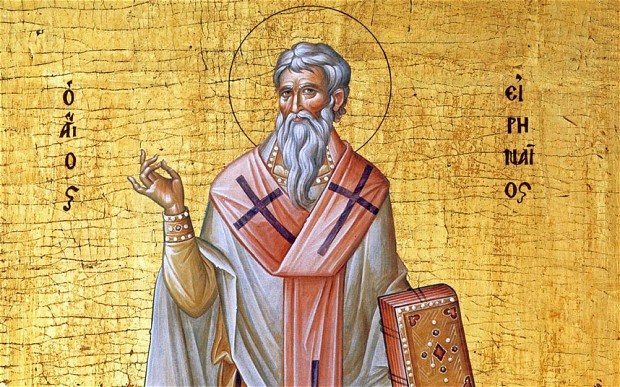
Image: Icon of Irenaeus of Lyon, Public Domain.
- Hist. Eccl. 5.26.[↩]
- Behr, John. Introduction to On the Apostolic Preaching, by Irenaeus (trans. John Behr; Popular Patristics Series 17; Crestwood, NY: St. Vladimir’s Seminary Press, 1997), 32.[↩]
- Behr, Introduction to Apostolic Preaching, 32–35.[↩]
- ‘The ecclesiastical governors of the Christians were taught to unite the wisdom of the serpent with the innocence of the dove; but as the former was refined, so the latter was insensibly corrupted.’ Edward Gibbon, The History of the Decline and Fall of the Roman Empire, ed. David Womersley (London: Penguin, 1996), 1.15.30.[↩]
- In The Demonstration of the Apostolic Preaching, Irenaeus only refers to the apostles seven times, and cites only Paul and John five times between them. Behr, Introduction to Apostolic Preaching, 15.[↩]
- Ign. Magn. 8.2.[↩]
- Ign. Phld. 8:2–9:1.[↩]
- 1 Apol. 31.7.[↩]
- Epid. 4.[↩]
- Epid. 40.[↩]
- Michael Reeves, Introducing Major Theologians: From the Apostolic Fathers to the Twentieth Century (London: IVP, 2015).[↩]