Hywel George
Christmas is a Christian festival which has, on the whole, been hijacked by worldliness. Nevertheless, the Church is willing to fight tooth and nail, vigil and matin, to retain Christmas. ‘Put Christ back in Christmas’ goes the determined slogan. The same obstinacy has not been extended to Allhallowtide, and especially to Halloween. No life-support for this holy season, Halloween has not only been abandoned to the world, but many Christians are even ready to throw it away as something corrupted beyond recovery, even essentially devilish or pagan.
I only want to lay out here the truth about Halloween’s heritage, as best as I can. The objective is mainly to dispel the ugly rumours around this holy night. If it turns out that Christians are again willing to claim Halloween as their exclusive privilege and pleasure one day, it may take more than telling this story. First, we’ll look at the date, and then the practices, before trying to tease apart its associations with ancient pagan worship.
A note to identify my own church tradition: I grew up and now minister in what is probably best described as British independent evangelicalism. This is a low church which, besides Christmas and Eastertide, is generally unfamiliar with or sceptical of liturgical calendars.
How We Reached 31st October
Jesus promised that whoever follows him will receive ‘persecutions; and in the world to come eternal life’ (Mark 10:30). This prophecy did not take long to reach fulfilment in Christian martyrs. In the 3rd–4th centuries especially, the Roman Empire did its best to help the promise along by persecuting the church.1 Naturally, many Christians wanted to honour their martyred friends and family by marking an annual day to remember them. As waves of persecution rose, a problem quickly appeared: there were not enough days in the year to remember all martyrs.
Roman persecution ebbed during the 4th century, and an annual day dedicated to honour all the martyrs simultaneously was becoming more mainstream. What we might call ‘all martyrs’ day’ emerged from common instincts, therefore it was observed on various dates around the Church. A common annual day for Christians to honour all martyrs is noted by Ephrem the Syrian (373) and John Chrysostom (407).2 In 609/10, the Roman Pope Boniface IV set the date to 13th May, at least in local practice and, later, in areas of Roman influence like England.3 Before the English monk Bede the Venerable went to be with Jesus in 735, he noted the feast for all martyrs on May 13th.4
However, Rome’s was not the only church tradition operating in the British Isles. In Northumbria, Alcuin of York was writing to the Bishop of Salzburg in 800, advocating 1st November to remember all the saints.5 Contemporary Irish martyrologies also recognise 1st November for All Saints’ Day.6 Precisely where this date comes from is not documented but it first appears in the 730s, as Irish missionaries brought their liturgical traditions to evangelise Bavaria.7 Through the influence of missionaries from the British Isles, and Alcuin in the Carolingian court, 1st November All Saints’ Day grew in popularity until it was regularised across the Frankish Empire by King Louis the Pious in 835.8 The Roman 13th May date continued in western liturgical lists until the 12th or 13th century, and there remains diversity of date and observance across the Church today.9
Medieval Halloween Practices
The word ‘Halloween’ comes from ‘Hallows’ Even’ and refers to the evening before All Saints’ Day. In medieval liturgies, Halloween was a formal vigil, ‘the Vigil of All Saints.’10 Christians across Europe attended late-night church services on Halloween to pray and prepare their hearts for All Saints’ Day the next morning. By the readings and prayers, they settled their minds on the victory which all saints have over death through Jesus’ resurrection. They rejoiced in the death of death at the hands of Jesus, who said of all his saints, ‘I will ransom them from the power of the grave; I will redeem them from death. O Death, I will be your plagues! O Grave, I will be your destruction!’ (Hos 13:14). Medieval liturgies for Halloween included the use of Psalm 149 (‘Let the saints be joyful in glory; Let them sing aloud on their beds’), Wisdom 3, (‘the souls of the righteous are in the hand of God, and there shall no torment touch them…their hope is full of immortality’), and passages of Revelation on the same themes.11
One of the earliest Christian practices was to visit graveyards at night and light up the tombs of Christians in certain hope of their resurrection, and this practice became welded to Hallowtide as it formalised in Europe.12 This signified the victory of the light of Jesus over the darkness of the grave and the hopefulness of those who sleep in Jesus. Not only among the earliest, it is one of the longest-lived traditions, remaining a global practice preserved in Europe, Asia, and the Americas today.
Later medieval Hallowtide observance in Europe included themed pageants. Medieval nativity plays are better remembered today and live on in primary schools, but there were many others through the Christian calendar which included Christians dressed as angels, devils, skeletons, and demons and sets including hell-mouths and open graves.13 Hallowtide pageants were especially suited to some of these themes, celebrating the victory of Christ and his saints over death. Some of these plays included depictions of saints and martyrs as gloriously undead.14 The late medieval penchant for skeletons and the like is no secret. What we could have seen of their costumes then, we can read of today in their pageant scripts and see preserved in stone and glass depictions today. These Hallowtide plays continued into the 19th century in Iberia, and in a tragically secularised form in England into the 20th century.15
Halloween Maligned
Halloween was attacked in Europe during and after the Protestant Reformation by Reformers and then Puritans because of its associations with the Roman Catholic doctrine of purgatory.16 This demonstrates that medieval Halloween was considered a Christian, not pagan, festival which by the 15th century included praying for the souls of the Christian dead. Church festivals have always been diverse and sometimes not so squeaky clean as they ought to be. Halloween, like Christmas, is no exception. Some so-called Halloween traditions have been ostensibly close to offering oblations to spirits, or straightforwardly pagan. These examples should be considered aberrations.
It cannot be denied that Halloween has always been a Christian festival. Yet, around the end of the 18th century, that’s exactly what happened. First the romantics, then cosplaying ‘neopagans’, tried to revive Samhain, or reimagine Halloween as a derivation of it. This is where most of the modern confusion originates.
What was Samhain?
It is hard to overstate how uncertain is our knowledge of what we call Samhain. The scant bits of evidence which we put together to form some picture may not even be related to one another. It is dubious work to even approach many conclusions. Nevertheless, we must say something about Samhain, which has been confused with Halloween.
‘Samhain’ refers to different annual festivals celebrated by different peoples in different ways, in different places, but around the same time—at the end of October and beginning of November.17 Samhain festivals probably marked the time of year, being the end of harvest and/or the consequent moving of herds. Samhain festivals were observed in places like Ireland, Brittany, and Scotland but with such diversity that there is simply no evidence that Samhain was a single pan-Celtic festival, as is sometimes suggested.18 The earliest sources referring to Samhain were made in 9th-century Ireland, mentioning communal feasts and annual treaties.19 Only much later medieval sources include suggestions about the liminality of the festivals and the unspeakable acts of sacrificing to demons foods, adults, and children.20
Historians are unsure about the extent to which (if at all) Samhain festivals related to the celebration, worship, or placating of the dead. They are even divided on whether the festivals included the formal worship of pagan gods.21 Only from the 18th century did people begin to attribute a multitude of practices to Samhain as if it were a single festival held consciously in common across Celtic lands. Into the 19th and 20th centuries, with renewed interest in all things Celtic and pagan, much confusion proliferated, and Samhain festivals were conflated with Halloween. It has been challenging to tease them apart ever since.22
Samhain and Halloween
Samhain and Halloween practices do not come close until the 16th century. Some descriptions of Scottish Samhain festivals included guising/mumming (fancy-dress) and children going door-to-door reciting songs or verses for food.23 Some see this as evidence of something like syncretism, but it isn’t. Neither of these practices are recorded with Samhain festivals, but both are documented with Halloween.
Children going door-to-door in the present-day fashion dates to at least the 15th century and was known as ‘souling.’24 Shakespeare mentions it in his 1593 The Two Gentlemen of Verona.25 Christian children would visit their neighbours during Hallowtide and offer to recite verses or to pray in exchange for a soul-cake (the Reformers and Puritans mentioned earlier were scandalised by these prayers). If souling had origins in ancient Samhain festivals, we might expect to find it exclusively and commonly in Celtic lands. Instead, it is recorded in late medieval Christian Britain, Flanders, Austria, and Germany. As to the fancy-dress, some want to imagine it replicates Samhain practices of mimicking or deceiving spirits. This is a noble guess, but the only people we find dressing up like this at the time were Christians in their pageants. The image in mind of 16th-century Halloween ought to be an infant saint offering to sing or pray for a soul-cake rather than a little demon extorting sweetmeats to spare an egging.
Corruption or Conquest?
Is there any relation between pagan Celtic festivals and Halloween? Apart from deliberate neopagan attempts to blend them, it is hard to see anything besides the time of year in which they are observed. Some have hoped to show that Christians cunningly took over Samhain. This has not been demonstrated, but roundly rebuffed.26 However, hasn’t Halloween been so terribly corrupted by pagan themes that it should be abandoned? To this I answer: only if our Living God cannot clean what is dirty or save what is lost!
As the plunder of Egypt and Jericho became the holy of holies and its treasury, so the treasures of the nations become the treasures of Christ and his Church (Exod 25; Josh 6:19; Hag 2:7; Rev 21:24). This concept of Christ conquering and claiming the nations’ plunder was probably in mind for Gregory the Great when he wrote his advice to Abbot Mellitus, a missionary to Anglo-Saxon Britain in the 7th century: ‘The temples of the idols in that nation ought not to be destroyed… it is requisite that they be converted from the worship of devils to the service of the true God.’27 It seems that whatever the Samhain festivals were, they were not replaced by Halloween, but rather the light of Hallowtide conquered their darkness.
Commercialisation and Rejection
Only in the last hundred or so years has Halloween being celebrated as a commercialised holiday rather than a sober holy day. In 19th-century North America, Irish and Scottish immigrants brought homely traditions into their new land. Not until 1917 was the first ‘trick-or-treat’ recorded as such.28 As a traditional feature of Halloween, it took another couple of decades to bed in. Not until the 1940s–1950s did the association of sweets begin to appear through confectioners taking advantage of the end of sugar rationing and the dawn of the ‘golden age of advertising’.29 Trick-or-treating has roots in Christian pageants and souling, but has been emptied of its light.
Having forgotten that Halloween is a Christian vigil for celebrating the victory of Jesus over death for his Church, many Christians want to reject it entirely. With a superficial glance at what has come of Halloween, this is understandable. A popular example of this effort is the ‘light party.’ Christian families and churches sometimes host such parties on Halloween to perform casual liturgies celebrating the light of Jesus shining in the darkness and his resurrection life triumphing over the grave. The irony is too much! We may do better to reclaim Halloween proper and fight for it as we do with Christmas, for Jesus’ sake.
For all the saints who from their labours rest,
who Thee by faith before the world confessed;
Thy name, O Jesus, be forever blest.
Alleluia, Alleluia!
Thou wast their Rock, their Fortress and their Might;
Thou, Lord, their Captain in the well-fought fight;
Thou, in the darkness drear, their one true Light.
Alleluia, Alleluia!
O blest communion, fellowship divine!
We feebly struggle, they in glory shine;
yet all are one in Thee, for all are Thine.
Alleluia, Alleluia!
And when the strife is fierce, the warfare long,
steals on the ear the distant triumph song,
and hearts are brave again, and arms are strong.
Alleluia, Alleluia!
But then there breaks a still more glorious day:
the saints triumphant rise in bright array;
the King of glory passes on His way.
Alleluia, Alleluia!
From earth’s wide bounds, from ocean’s farthest coast,
through gates of pearl streams in the countless host,
in praise of Father, Son, and Holy Ghost.
Alleluia, Alleluia!30
Hywel George is a pastor in Maesycwmmer, Wales, United Kingdom. He is a graduate from Union School of Theology and lectures Church History in Valleys School of Theology.
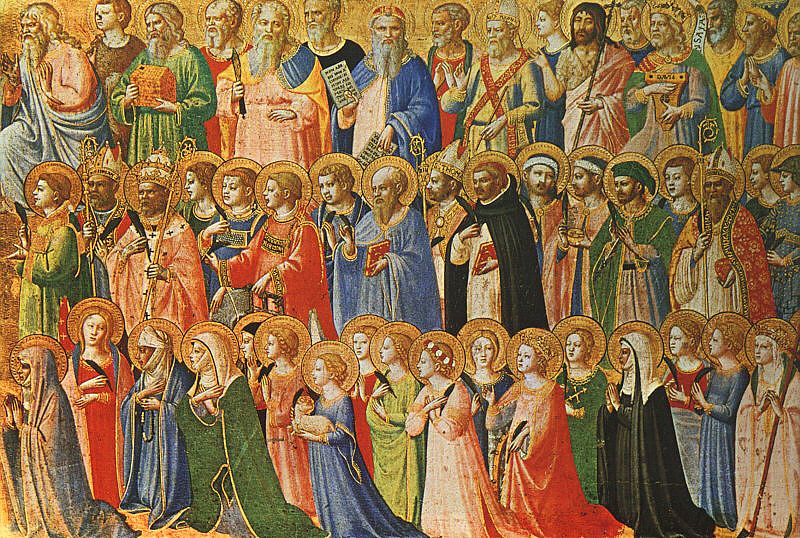
Image: Fra Angelico, The Forerunners of Christ with Saints and Martyrs
- At times, such as under Emperor Diocletian, this was with the expressed intention of eradicating the faith entirely. Eusebius, Hist. eccl., 8.2.[↩]
- Ephraim Syrus, The Nisbene Hymns 6 (NPNF² 13:334—336). John Chrysostom, De sanctis martyribus (PG 50:645, 705).[↩]
- The occasion was the dedication of the Pantheon as a church to Mary and All Martyrs. Liber Pontificalis, “Life of Boniface IV” 68 (Duchesne 1:317).[↩]
- Bede, The Reckoning of Time, trans. Faith Wallis; TTH 29 (Liverpool: Liverpool University Press, 1999), 227. Bede, Hist. eccl. 2.4 (The Ecclesiastical History of the English People, trans. Bertram Colgrave, ed. Judith McClure and Roger Collins, OWC, Oxford: Oxford University Press, 1999), 74–76. Bede, Martyrologium, 13 May (The Complete Works of Venerable Bede, trans. J. A. Giles, London: Whittaker, 1843, 4:66). There is a martyrology attributed to Bede which acknowledges the 1st November date, however this martyrology also refers to events after Bede’s death so cannot have been his work. Some suspect it was written by Alcuin and catalogued with Bede.[↩]
- Alcuin, Epist. 193 (MGH Epist. 4:320–321). Martyrologium Poeticum (Metrical Martyrology of York), lines 66–68.[↩]
- Félire Óengusso Céli Dé: The Martyrology of Oengus the Culdee, 1 November, ed. Whitley Stokes, HBS 29 (London: Harrison and Sons, 1905), 232. The Martyrology of Tallaght, 1 November, ed. Richard Irvine Best and Hugh Jackson Lawlor, HBS 68 (London: Harrison and Sons, 1931), 86.[↩]
- Carl I. Hammer, “’For All the Saints’: Bishop Vivolo of Passau and the Eighth-Century Origins of the Feast,” Revue Mabillon 15 (2004): 5–26, https://doi.org/10.1484/J.RM.2.303549. I am extremely grateful to P. J. Blackham at the Global Church History Project for bringing my attention to this vital source.[↩]
- Decree of Thionville/Aachen (835), Capitularia regum Francorum, no. 197 (MGH Capit. 2:51–52). Ado of Vienne, Martyrologium, 1 November (PL 123:387).[↩]
- Sicard of Cremona, Mitrale 9.47 (PL 213:414).[↩]
- Gregory DiPippo, “The Vigil of All Saints,” New Liturgical Movement, October 31, 2025.[↩]
- René-Jean Hesbert, ed., Antiphonale Missarum Sextuplex (Rome: Herder, 1935), entry 178b.[↩]
- Jerome, Adversus Vigilantium 7 (NPNF² 6:420–21). Synod of Elvira (c. 305), Canon 34 (Mansi 2:11).[↩]
- The York Play of Pageants, Play 1 (in The York Plays, ed. Richard Beadle, London: Edward Arnold, 1982). The Chester Mystery Cycle, vol. 1, ed. R. M. Lumiansky and David Mills, EETS 3 (London: Oxford University, 1974), 12–15. R. W. Ingram, ed., Coventry, Records of Early English Drama (Toronto: University of Toronto, 1981), especially 164, 474. Edmund Grindal, The Remains of Edmund Grindal, D.D., Successively Bishop of London, Archbishop of York, and Archbishop of Canterbury, ed. William Nicholson, Parker Society 9 (Cambridge: Cambridge University, 1843), 135–37.[↩]
- Beadle, “The York Pageants,” Plays 37, 48.[↩]
- “Rudheath Souling Play (TDRG Ref: 94sj77ha),” Master Mummers Folk Play Scripts Explorer, mastermummers.org. Teófilo Braga, “Crenças e festas publicas,” in O povo portuguez nos seus costumes, crenças e tradições, vol. 2, Crenças e festas publicas, tradições e saber popular (Lisbon: Livraria Ferreira, 1885), 250.[↩]
- David Cressy, Bonfires and Bells: National Memory and the Protestant Calendar in Elizabethan and Stuart England (Berkeley: University of California, 1989). For example, New England Puritan Rev. Increase Mather (1639–1723) called Halloween an ‘abominable shame’ and lamented that anyone would celebrate ‘so vile a piece of heathenism.’ Increase Mather, A Testimony Against Several Prophane and Superstitious Customs Now Practised by Some in New-England (London: s.n., 1687), 19.[↩]
- Ronald Hutton, The Stations of the Sun: A History of the Ritual Year in Britain (Oxford: Oxford University Press, 1996), 360–70.[↩]
- Simon James, The Atlantic Celts: Ancient People or Modern Invention? (Madison: University of Wisconsin, 1999), 39–45, 68–74, 134–138. Dimitra Fimi, “Samhain or Halloween? The ‘Ancient Celtic Year’ in Contemporary Children’s Fantasy,” Gramarye: The Journal of the Chichester Centre for Folklore, Fairy Tales, and Fantasy 11 (2017): 51–63.[↩]
- Elizabeth A. Gray, ed. and trans., Cath Maige Tuired: The Second Battle of Mag Tuired, Irish Texts Society 52 (Naas: Irish Texts Society, 1982). Thomas Kinsella, trans., The Táin: Translated from the Irish Epic Táin Bó Cúailnge, Ulster Cycle (Oxford University Press, 1969).[↩]
- R. A. Stewart Macalister, ed. and trans., Lebor Gabála Érenn: The Book of the Taking of Ireland, vol. 1, Irish Texts Society 34 (Dublin: Educational Company of Ireland, 1938). Nicholas Rogers, Halloween: From Pagan Ritual to Party Night (Oxford: Oxford University, 2002).[↩]
- Hutton, Stations of the Sun, 371–385. Marie-Louise Sjoestedt, Gods and Heroes of the Celts (trans. Myles Dillon; Berkeley: Turtle Island, 1982), 50–55.[↩]
- For a main culprit of recasting Samhain, see John Toland, A Critical History of the Celtic Religion and Learning (London: Lackington, Allen, & Co., 1815; repr. of the 1726 ed.). For 19th– and 20th-century confusion see Hutton, Stations of the Sun, 371–385 and Nicholas Rogers, Halloween: From Pagan Ritual to Party Night (Oxford: Oxford University, 2002).[↩]
- The use of turnip lanterns (later, pumpkins also) was not widespread for a further two centuries again (C18th). Ibid. F. Marian McNeill, The Silver Bough: Vol. 3: A Calendar of Scottish National Festivals (Glasgow: William MacLellan, 1961).[↩]
- John Aubrey, Remaines of Gentilisme and Judaisme, ed. James Britten, PFLS 4 (London: W. Satchell, Peyton, & Co., 1881). Aubrey records first-hand, 17th-century accounts of families preparing and distributing traditional soul-cakes.[↩]
- William Shakespeare, The Two Gentlemen of Verona ii.1.[↩]
- Fimi, “Samhain,” 51–63.[↩]
- Pope Gregory I, Epistola ad Mellitum, in Bede, Hist. eccl. 1.30. The same conquest of darkness by the light of Christ we already saw when Boniface IV rededicated the Pantheon to Mary and all saints (shortly after Gregory wrote to Mellitus).[↩]
- The Herald (Sault Ste. Marie, Ontario), November 1917. The Leader (Regina, Saskatchewan), November 1, 1920. Dictionary of Canadianisms on Historical Principles, 3rd ed. (DCHP-3), s.v. “Trick or Treat.”[↩]
- Samira Kawash, Candy: A Century of Panic and Pleasure (New York: Faber & Faber, 2013). Kawash chronicles how candy conglomerates systematically co-opted Halloween after WWII, successfully transforming a localized, mischievous neighbourhood tradition into a highly corporate, consumer spending event.[↩]
- William Walsham How, “For All the Saints,” in Ancient and Modern: Hymns and Songs for Refreshing Worship (London: Canterbury Press, 1983), hymn 296.[↩]